
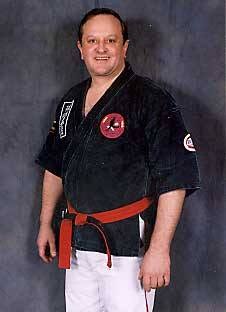
George Dillman
George Dillman did not become notorious for teaching that the body has vulnerable places. Every competent fighter already knows that. He became notorious for claiming that an opponent could be knocked out without contact by chi — an alleged force which disappears precisely when the other person is not cooperating.
George Dillman: What is real, and what is being sold
Dillman is a long-established American martial-arts instructor, author and seminar teacher. His own organisation, Dillman Karate International, promotes Ryukyu Kempo, tuite, pressure points, grappling and knockout techniques. That is a genuine career in martial arts. A hard strike to the jaw, neck or body can hurt somebody; particular grips and strikes can create pain, disrupt posture and sometimes cause injury. None of that requires magical thinking.
The fraud begins when ordinary anatomy and real martial experience are used as a platform for something else: remote knockouts, chi projection and a claim that invisible force can disable a person without physical contact. In an interview with Black Belt, Dillman said of chi, “It does exist. It is for real.” That is not a poetic description of breathing, balance or confidence. It is an empirical claim about an external effect on another body.
The test that mattered
Seminar demonstrations are a poor way to test a remarkable ability. Students know the instructor, expect the movement, often want the technique to work and have usually practised the required fall. The useful test is simple: use a person who is not in the school, remove cues where possible and see whether the result remains.
That is effectively what happened in National Geographic Channel’s Is It Real?. A Dillman protégé, Leon Jay, attempted a no-touch knockout on independent investigator Luigi Garlaschelli. It failed. Black Belt’s later account confirms both the failed attempt and Dillman’s explanation: time-zone adjustment and Jay’s personal distraction. The Montreal Gazette recorded another explanation attributed to Dillman — that the subject’s tongue position or raised toes could nullify the force.
Those are not explanations that make the claim stronger. They make it unfalsifiable. If success depends on belief, hidden posture, toe position, tongue placement, mood, travel or any other condition discovered only after failure, the claimed power has no reliable independent meaning. A self-defence method that works only on believers is not self-defence. It is suggestion.
Pressure points are not a loophole
Dillman’s defenders sometimes answer criticism of no-touch knockouts by pointing to pressure-point work. That changes the subject. Touching a person is not the same as knocking them down from a distance. A 2020 paper, “Pressure point knockouts and neurodynamics”, discusses possible physiological mechanisms for certain contact techniques, but it also notes that published research is sparse and that the earlier monitored study did not find a consistent mechanism. It provides no support for remote force, mind-over-body knockouts or chi projection.
That distinction matters. Contact techniques can be painful or dangerous, especially around the head and neck. They should not be copied casually from a DVD. But a partial medical discussion of contact effects cannot be stretched into evidence that a hand waved at a stranger can switch off consciousness. The leap from one proposition to the other is where the sales pitch becomes nonsense.
George Dillman: The convenient contradiction
Dillman’s commercial material presents itself as self-protection: practical information that should not be lost, offered through books, DVDs and seminars. The no-touch material is sold as part of the authority of that system. Yet it cannot survive the basic demand placed on any practical claim — demonstrate it reliably on a subject who has no reason to play along.
One can be charitable about the exact mechanism behind the demonstrations. It may involve conscious cooperation, expectation, group pressure, balance, ritual or some mixture of all five. It does not need an accusation of conspiracy to reach the obvious conclusion. The claimed ability failed when independently tested, and no credible evidence shows that it works.
Why this is fraud
Dillman’s real experience does not validate the false part of the package. Years in karate do not make invisible force real. Books, rank and a room full of impressed students do not convert a failed no-touch demonstration into evidence.
The fraud is specific. Dillman promoted a purported combat ability — disabling an opponent through chi without contact — that was not established, failed when tested outside the compliant seminar setting, and has been insulated from failure by post-hoc excuses. Presenting that as advanced martial knowledge, let alone dependable self-defence, is dishonest in substance.
There may be value in drilling, fitness, timing and sensible physical self-protection. There is no value in teaching people that an attacker can be stopped by a hand gesture while they wait patiently to be persuaded.
Sources
- Dillman Karate International — the organisation’s current description of its martial-arts instruction and products.
- Black Belt, “The Truth and Legend of Chi – Part 2” — Dillman’s stated belief in chi, the failed National Geographic demonstration, his response and the limits of the earlier contact-technique monitoring.
- Joe Schwarcz, “The Right Chemistry: Taking a kick at the no-touch knockout”, Montreal Gazette — the National Geographic failure and the reported post-failure explanations.
- “Pressure point knockouts and neurodynamics”, Chiropractic & Manual Therapies (2020) — the limited research base for contact pressure-point techniques; not evidence for no-touch force.
Research note: the supplied Facebook group search requires login and was not used as evidence. The assessment relies on accessible promotional material and independent reporting.
Pingback: Yanagi Ryuken - Where Extraordinary Claims Meet Facts
Pingback: Vadim Starov - Where Extraordinary Claims Meet Facts