
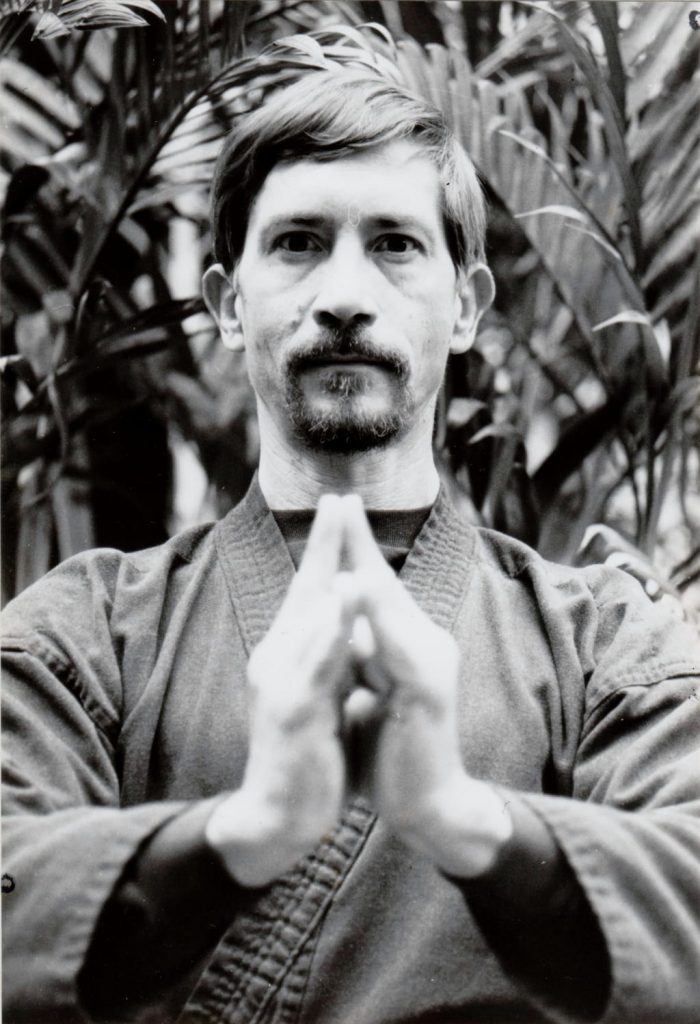
Ashida Kim
Ashida Kim made a commercial career from the promise that ninja lore could turn an ordinary buyer into something exceptional: unseen, unbeatable and privy to a secret Japanese inheritance. The books are real. The marketing is real. The inherited Kōga authority is not established.
Ashida Kim: What is being sold
Ashida Kim is the pen name used by the author and Dojo Press figure behind a substantial catalogue of ninja-themed books, videos, memberships and certificates. That body of work is not in dispute. Nor is it inherently dishonest to devise a modern martial-art system, write about it, or teach practical escape and self-protection.
The problem is the other product. His own material presents an old Kōga ninja inheritance: the art of invisibility, the Kōga ninja clan, ancient secret transmission and a tradition which supposedly survived into his teaching. Dojo Press sells Koga Ninjitsu as confirmation of what Kim has said for fifty years, while its wider catalogue calls students into a covert ninja brotherhood and offers ranked certification through a central office.
That is not merely atmospheric language around a modern course. It is a claim to historical authority. If it is offered as such, it needs a historical chain strong enough to bear the weight.
The claimed powers fail the ordinary test
The sales material does not confine itself to plausible instruction. The Black Belt Syllabus advertises the ability to “appear and vanish at will”, dodge bullets, penetrate solid matter, stop the heart and place a hand in a live steel trap unharmed. Those are claims of extraordinary physical power, not ordinary self-defence drills or metaphor.
There is no independently verified demonstration of any of them. In fairness, Kim later writes that he has “no magic power” and describes throwing sand in an attacker’s eyes as one form of invisibility. That is sensible enough as a crude escape tactic. It does not rescue advertising which offers bullet dodging, solid-matter penetration and an apparent heart-stopping feat as part of the same authority.
The relevant distinction is not mystical versus sceptical temperament. It is whether a seller is representing an effect as a repeatable ability and can demonstrate it under conditions that rule out theatre, editing, compliant partners and misunderstanding. Here, the demonstrable evidence is absent.
A challenge designed to avoid the point
Kim’s response is his long-running $10,000 Challenge. But it is not an open test of the extraordinary claims advertised in his teaching. Before negotiations about date and venue, it requires a challenger to pay him $10,000, post a $25,000 appearance bond, pay travel and accommodation for him and three others, supply athletic documentation, and sign an extensive waiver. A bout under those conditions could show that somebody won a bout. It could not establish invisibility, mind control, bullet dodging or the historical transmission of Kōga Ryū.
Fighting ability is not evidence of lineage, and a financial obstacle course is not evidence of supernatural ability. Treating either as a substitute is misdirection.
Ashida Kim: The missing bridge to Kōga
Classical Japanese traditions do not establish succession by costume, titles or an exciting origin story. They establish it through named teachers, a traceable line, licences and the recognised transfer of authority. As Koryu.com’s account of transmission and succession explains, the lineage, densho and the authority of the designated head are central to that claim.
Kim’s material provides no independently checkable bridge of that kind. One Dojo Press account says he had travelled to Japan and studied under various ninjutsu masters. Another says that, when asked for documentation or even the name of a teacher, he replied that he had learned in the Army and that “no name, no art” required secrecy. The later account of the “Guru” still does not identify a teacher whose transmission can be checked. Secrecy is an explanation for the missing evidence; it is not evidence in its place.
The historical obstacle is sharper still. Seiko Fujita (1898–1966), identified as the final head of the Kōga Ryū Wada-ha family tradition, repeatedly said he had taught the ninjutsu to nobody and would let it die with him. Japanese material discussed by researcher Don Roley records no successor; Fujita’s books, scrolls and artefacts went to collections at Odawara and the Iga area rather than to a private heir. That source is not a substitute for primary archival work, but it accurately sets the evidential question: anyone claiming a later private Kōga transmission needs to identify and document the route around Fujita’s stated decision. No such route is supplied here.
More broadly, Koryu.com concludes that independent ninjutsu no longer exists as a classical ryū-ha; what is normally taught under the name is a recent collection of unarmed and weapons arts. That need not demean modern training. It does make an inherited Kōga label a serious claim rather than a bit of exotic decoration.
The certificate trade
Dojo Press openly offers a $55 “Ninja Certification”: a membership certificate at Genin, described as black-belt-equivalent first degree, with an ID card and membership handbook. The same page offers video testing for higher or equivalent rank and presents the central office as able to validate the holder’s credentials. A certificate can of course signify membership of a private organisation. It cannot turn an unverified system into a transmitted Japanese classical school.
This is where the fraud is clearest. A buyer is not being given a conventional martial qualification backed by an independently recognised line of instructors. He is being sold participation in an organisation that asserts its own rank, validates its own certificate, and wraps that transaction in the prestige of ancient Kōga ninjutsu.
Conclusion
Ashida Kim is entitled to write, to perform, to promote his own modern system and to sell books. He is not entitled to have impossible claims, private certificates and an unnamed secret teacher treated as proof of inherited Kōga authority. The record does not support it.
The honest description is a modern American ninja-themed commercial system, built from eclectic martial material, performance and mythology. Selling that as a self-created system would be one thing. Selling it with the authority of a surviving Kōga lineage is fraudulent in substance: the crucial inheritance is asserted, but no verifiable transmission exists.
Sources
- Dojo Press, “Black Belt Syllabus” — the advertised extraordinary abilities and challenge to duplicate the alleged feat.
- Ashida Kim, “$10,000 Challenge” — the published financial, medical and legal conditions.
- Dojo Press, “Ninja Certification” — membership, certificate, rank equivalence and video testing.
- Dojo Press, “Koga Ninjitsu” — the Kōga framing and promotional biography.
- Dojo Press, “Guru and the Ninja” — the stated explanation for the absent named teacher and documentation.
- Ashida Kim, “Ashida Kim on Fraud” — his later qualification of “invisibility” and the honorary 10th-dan claim.
- Meik Skoss, “Transmission and Succession in the Classical Arts”, Koryu.com — classical succession and documentary authority.
- Koryu.com FAQ — its account of independent ninjutsu’s status outside classical koryū.
- Don Roley, “Fujita Seiko, The Last Koga Ninja” — Fujita’s reported decision not to transmit the art and the location of associated collections.
Research note: the supplied Facebook group search requires login and was not used as evidence. This assessment relies on accessible primary promotional material and independent historical commentary.
Pingback: Count Dante - Where Extraordinary Claims Meet Facts