
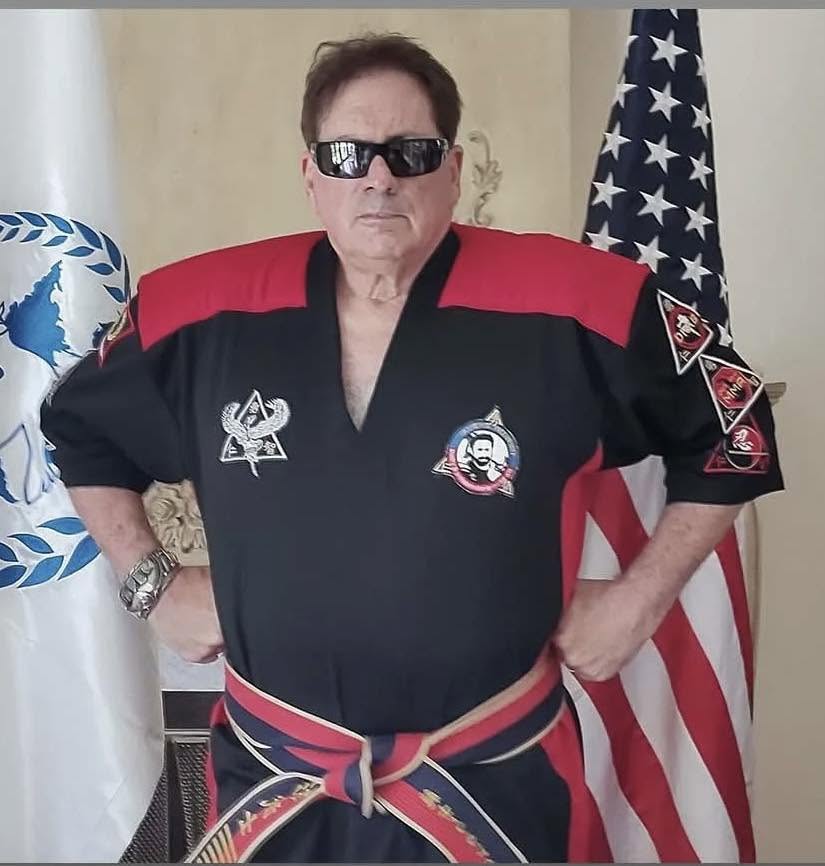
Frank Dux
Bloodsport is a good martial-arts film, carried by the people who made it rather than by the historical reliability of its subject. That distinction matters. The film turned an improbable martial-arts story into cultural furniture. Once enough people have heard a story often enough, asking for the boring parts — records, witnesses, dates, organisers and results — can look almost rude. It is not rude. It is the job.
This file concerns Dux’s headline claims: the secret 1975 Bahamas Kumite, a record-breaking tournament run, the mysterious teacher Senzo “Tiger” Tanaka, and a military record presented as proof of exceptional experience. It is not a claim that nobody who trained with Dux learned anything useful. It is a question of whether the grand narrative used to sell authority survives ordinary scrutiny.
Frank Dux: The story that became Bloodsport
Dux’s public version is the stuff of a perfectly engineered martial-arts fantasy: a Western student chosen by a Japanese master; a secret contest held beyond normal oversight; a title won against international killers; and numbers so impressive that they need their own display cabinet. The 1988 film took that material and made it emotionally true for a generation of viewers, which is not the same thing as making it historically true.
Dux’s own website still presents the International Fighting Arts Association as the body behind the Kumite and lists a 1975–1980 championship, 56 consecutive knockouts, a 0.12-second knockout punch, a 72 mph kick and a final 329-match record. Those are Dux’s claims. They are not independently established sporting records. Read the claims as presented by Dux’s site.
What scrutiny found
In 1988, Los Angeles Times reporter John Johnson examined the tournament, the teacher and the military story. The report records that the Bahamas Ministry of Sports had no recollection of the alleged event; that experts consulted by the paper could find no independent trace of Tanaka; and that the International Fighting Arts Association trail led back to Dux. It also reported that the trophy displayed as evidence had components identified by a San Fernando Valley trophy maker.
Those findings matter because they are not aesthetic objections. They concern the ordinary evidence a significant international competition ought to leave behind: organisers, venue knowledge, officials, competitors, records and a verifiable trophy trail. A secret tournament may explain why there was no television coverage. It does not explain why its supporting infrastructure becomes difficult to locate when somebody bothers to look.
The same report describes Dux’s military claims as contradicted by the Marine Corps records available to the paper. Dux’s response was that his file had been sabotaged to discredit him. That is an explanation, not corroboration. The important distinction is routinely lost in martial-arts folklore: an answer to a discrepancy is not evidence that the original claim was true.
The numbers are not a side issue
Martial artists are used to inflated numbers. A seminar advertises a 10th dan. A man who competed twice becomes a “world champion”. A story becomes more dramatic each time it is retold. Dux’s numbers are different because they are central to the proposition. The 56 consecutive knockouts, the supposed speed records and the 329-match career are not colour around the edges. They are the machine’s engine.
That is why changing descriptions of the event matters. Dux’s current official biography presents the Kumite as a multi-day, round-robin-style endurance contest with a final stage, while also saying that earlier reporting misrepresented the format. A serious historical claim should become clearer under examination. It should not require the tournament to change shape whenever the previous version develops a logistical problem.
Frank Dux: Black Belt, publicity and the error people keep making
Dux’s 1980 Black Belt coverage is often treated as a stamp of independent verification. It was not a permanent certificate of truth. Johnson reported that the writer later said information received after publication had raised questions about Dux’s military story, while the magazine’s editor said there was no evidence for a tournament of the claimed kind. A magazine profile can start an investigation; it cannot end one.
This is a familiar trick of social proof. Get a story into a magazine, then point to the magazine as proof that the story was checked. Years later, the original article acquires an authority it never had. Readers remember the glossy page, not the thinness of the underlying trail.
The sensible conclusion
There is a difference between saying that Dux was physically incapable of fighting and saying that the public case for his legend is not good enough. The first claim would require evidence this site does not have. The second does not. The central claims rely heavily on Dux’s own account, while the independent checking described by the Los Angeles Times found contradictions and missing corroboration where it should have been easiest to find.
That makes Frank Dux a useful fraud file. He is not merely a man with an implausible anecdote. He is an example of how martial authority can be assembled from secrecy, spectacle, selective documents and the public’s willingness to mistake a good story for a demonstrated fact. Bloodsport made the story famous. Evidence did not make it stronger.
Sources
- John Johnson, “NINJA: Hero or Master Fake?”, Los Angeles Times, 1 May 1988.
- John Stewart, “Kumite: A Learning Experience”, Black Belt, November 1980.
- Frank Dux official site: Titles and World Records — used here as a source for Dux’s own present-day claims.
- Frank Dux official site: “Kumite: The Legend of Bloodsport” — used here as a source for Dux’s current account of the format and supporting narrative.
Pingback: Ron Collins - Where Extraordinary Claims Meet Facts
Pingback: Dan Harmon - Where Extraordinary Claims Meet Facts